2025-06-25
Deep dive on battery cell chemistry, components and where innovation is headed
Understanding basic electrochemistry is necessary to contextualise innovations in the sector. Stepping through these novel cell chemistry innovations suggests the eventual steady state will look multimodal — with different chemistries privileged for different use cases rather than a one-size-fits-all super-chemistry.
Following on from my previous article I need to go a lot deeper on the question of "how does a battery work" before it is worth introducing innovative chemistries, novel manufacturing and the applications of AI in the field. I have been learning a lot about how exactly these fascinating devices work and it contextualises the investment and innovation in the space a lot. We need to understand the state of the union, so to speak, before we seek to improve it. For external views the best write-ups I read are from science.org.au and Ossila (where you can even buy your own LFP powder, it seems).
Let's address this from a couple of angles:
- Electrochemistry — stepping through the specific reactions which happen in different parts of a battery cell
- Components — breaking down each part of the battery to understand its role
- Alternative chemistries — comparing the most commonly used current chemistries
1/ Electrochemistry
The core principle of lithium-ion batteries is that they facilitate the movement of lithium ions (Li+) from the anode (negative) to the cathode (positive) through an electrolyte — the respective electrons from each are unable to flow and must travel through an external circuit, providing useful energy.
A tale of two reactions
(Dis)charging a battery occurs due to a pair of "half-reactions" occurring one at each electrode. In a battery's fully charged state there is a voltage differential between the electrodes (which varies based on the chosen materials) which is the instigator for the reaction. During discharge, lithium ions move from the anode (LiC6 → C6 + Li+ + e-) through the electrolyte to intercalate at the cathode (FePO₄ + Li⁺ + e⁻ → LiFePO₄). To maintain the charge balance at both ends, the electrons from that equation (e-) move through the external circuit (they cannot get through the electrolyte and separator) to recombine at the cathode. The inverse happens when an external power source is applied to facilitate charging.
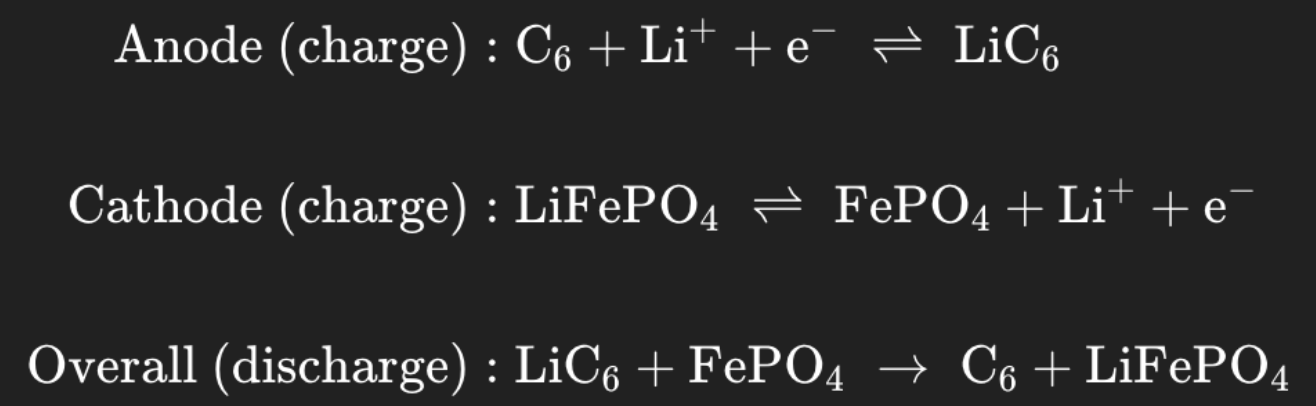 Figure 1 — the two half reactions and the whole in an LFP cell.
Generally, since the original source of lithium is in the cathode, LFP cells are built in a discharged state and need to be formed in their first charge, which is a key part of cell manufacture. This is because the cathode contains lithium and the anode is unlithiated graphite; during first formation is when Li+ from the cathode creates LiC6 at the anode. See my previous article for more on this process.
2/ Components
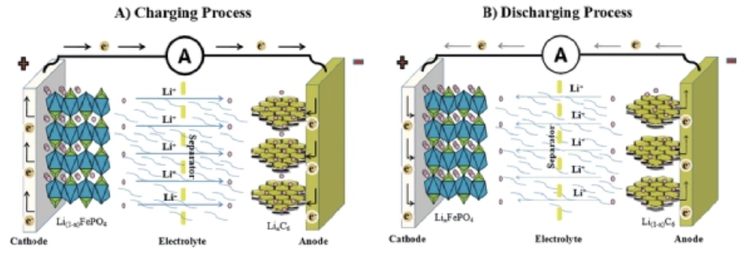 Figure 2 — the different components in an LFP cell and their role in charge/discharge.
Cathode
The cathode of a battery is often referred to based on the cathode active material used, e.g., an LFP or NMC cathode. However, the cathode material which is applied onto the current collector material (usually aluminium foil) is a composite of multiple materials:
- Cathode active material: in a typical LFP cell this is olivine-structured lithium iron phosphate.
- Binder: typically a polymer-based binder is used such as polyvinylidene fluoride (PVDF)
- Conductive additive: typically carbon black. A fine carbon network (e.g., acetylene black or Super P) is added to the LFP since it is not inherently a good conductor by itself
- Solvents: these get burnt off in ovens later in the process (see previous article about the manufacturing process)
The cathode material slurry is cast then dried onto an aluminium foil current collector (10–15 µm) which is chosen since it is lightweight and resists corrosion.
Anode
Similarly, the anode material applied on the copper current collector is a mix of:
- Anode active material: typically made out of graphite (a form of carbon) since its layered or latticed structure enables lithium ions to intercalate (forming LiC6)
- Binder: typically binders are CMC/SBR water-based systems; PVDF is uncommon for graphite anodes.
- Conductive additives and solvents as above
Typically the anode current collector is copper foil (8–10 µm) which resists alloying with lithium, has high conductivity and stability at anode potentials.
Electrolyte
Typically a liquid solution of lithium salt in organic solvents, e.g., LiPF6 (lithium hexafluorophosphate) dissolved in carbonate solvents (ethylene carbonate and dimethyl carbonate). The purpose is for the electrolyte to fill any pores in the electrodes and separator and facilitate the transport of lithium ions back and forth in the cell. The electrolyte is chosen for its ionic conductivity, stability at cell voltage and ability to wet and have good contact with electrodes.
The trade-off is that LiPF6 is used since it meets these criteria and enhances what is known as SEI (Solid Electrolyte Interphase) formation. This is where the electrolyte decomposes during initial charge cycles and creates a solid film on the anode surface — actually a desirable quality, since this film supports cell performance. However, this material is extremely sensitive to water, and the carbonate solvents are flammable (if heated above 60C or overcharged) and can be a key contributor to battery-related fire and thermal issues.
Separator
Small but critical, the separator is a thin polymer film that separates the anode and cathode to prevent direct contact (a short circuit), is "microporous" and allows lithium ions to flow through (ionic conductivity) but prevents electrons from passing through (electric insulator). Separators are almost always made out of polyolefin polymers, typically bilateral polyethylene (PE) and polypropylene (PP), totalling only ~15–25 microns. As a safety measure they are sometimes designed to melt and form a blocking layer at temperatures above 130C.
Enclosure
Finally, the more mechanical components. The current collectors on each electrode are connected to tabs which are welded into cell terminals (think the + or − end of a double AA). Similarly, the final cell is enclosed and welded into a cylindrical can, prismatic can or flexible polymer pouch cell. When working with liquid electrolyte the enclosure needs to be hermetically sealed.
3/ Alternative chemistries
The dominant way to improve or tailor battery performance for different use cases is to use different chemistries. One kind for EVs, one for storage and more yet for highly specialised devices like smartphones which will pay a massive premium to get that last extra 10% of energy density.
Key battery metrics
The following are the key metrics used to compare the performance and value of batteries between chemistries (or even between companies, etc):
- Current and power: Amperes (A) and (kilo)Watts (kW)
- Cost: $/kWh (can be measured at cell, pack or installed points)
- Energy density (volumetric): kWh/L
- Energy density (gravimetric): kWh/kg
- Cycle life: number of full battery cycles, typically to 80% remaining capacity
- Round trip efficiency: %
Now we can compare the dominant and emerging chemistries using some of these metrics.
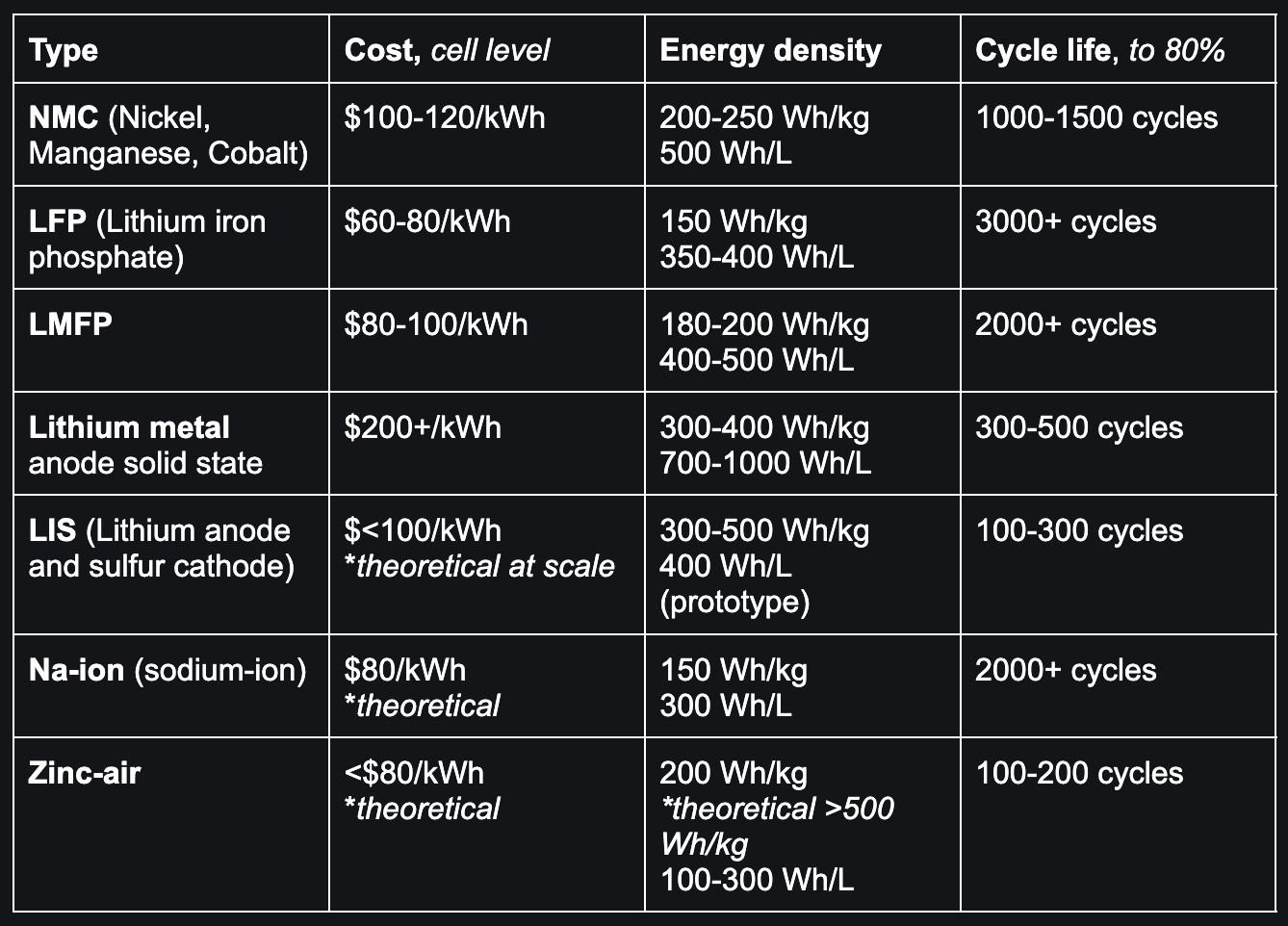 Figure 3 — high-level cost and performance comparison between battery technologies.
There are three key takeaways from this I would like to draw attention to:
- The work is ongoing. This is only a subset of the myriad of chemistries being developed across Australia and the world. For each bucket we refer to as something like "LMFP" there is also a large number of permutations and ongoing research refining and tweaking what this chemistry means. There is no single formula every manufacturer uses and significant work is ongoing in the sector. Thus far there is no clear winner around which research has evolved.
- There are inevitable trade-offs. The fundamental electrochemistry and physical properties of cells means there will be trade-offs between what we are solving for. Generally, the cheapest cells will use cheap materials and be easier to make (take up more space), or the most long-lasting cells will be worse at rapid power delivery, etc. It appears unlikely a "super chemistry" will come along and make all others redundant given this property. This is why even now the dominant LFP chemistry is about 60% of production.
- Batteries are likely to reach a multimodal end steady state. The implication of this physical property is that as batteries expand their use cases even more, we are likely to see chemistries "matching" with use cases. High-end EVs using NMC or LMFP, commodity ones and home storage using LFP, grid-scale storage using sodium-ion, ultra-high-end electronics using lithium sulfur, etc. This end state can be contrasted to something like solar, where PV cells are largely all based on a single dominant technology and the same general cell is used for the majority of deployments. This presents significant innovation opportunities in batteries.
Conclusion
Cast iron is the undisputed king of cookware but it is tricky to maintain and heavy, stainless steel is hard to work with but effective, non-stick is full of PFAS… as with batteries, choosing the right tool for the job is the trick with chemistries. Even better, there is continued innovation at the fringes both to make what we already use a bit better and to commercialise brand new chemistries that are a lot better.
A good chef builds their kitchen with the right tools for the right uses — much as OEMs, EV manufacturers and grid storage developers will naturally diverge in their preferences and lead to a multimodal battery market in the future with a mix of chemistries. This challenges some of what we discussed last time about the massive gains from scale cell manufacturers have made. In the future, manufacturers, like users, will need to be flexible working with different chemistries and designs.
Note: this article was developed with support from AI tools.
Originally published on LinkedIn.